
The Akihabara Posture Hack: Why Japanese Ergonomics & Movement Beat Lower Back Pain
At Nutritional Physical Therapy, we talk a lot about the power of an anti-inflammatory diet. We analyze how cutting excess sugar stops collagen from becoming brittle, how hydration keeps intervertebral discs plump, and how bioavailable protein fuels tissue repair.
But here is the clinical truth that every clinician and patient needs to remember: Nutrition provides the building blocks, but movement and biomechanics are key.
You can eat the cleanest, most anti-inflammatory diet on earth, but if you sit slouched in a rigid office chair for eight hours a day, mechanical shear force will win every single time.
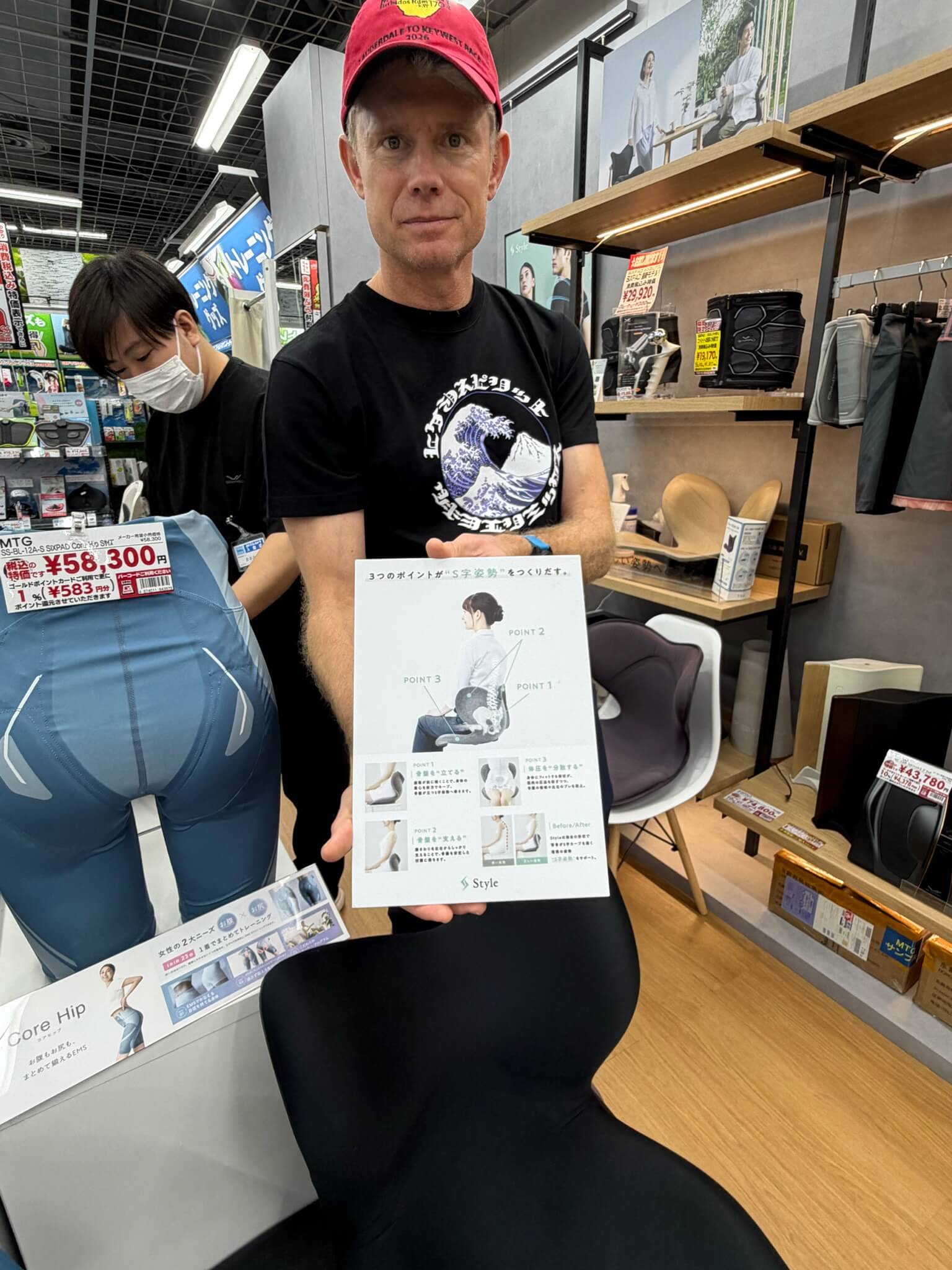
During our recent trip for The Japan Longevity Series, we explored Akihabara—Tokyo’s high-tech electronics district. Among the robotics and neon lights, we uncovered an exceptional example of proactive Japanese ergonomic design: the MTG "Style" posture-support cushion.
Here is what this Japanese posture tech teaches us about pelvic stabilization, spine biomechanics, and why your sitting environment matters just as much as your diet.
The Biomechanics: S-Curve vs. C-Curve Posture
When you look at human spinal anatomy, the lumbar spine is naturally designed with an inward curve known as lumbar lordosis. When viewed from the side, a healthy spine forms an "S-curve." This alignment evenly distributes gravitational loads and acts as a natural shock absorber for your body.
What Happens in Poor Posture (The "C-Curve")
When you sit on a flat, unsupportive seat or slouch forward at a desk, your pelvis tilts backward (posterior pelvic tilt). This flattens your lumbar curve, forcing your spine into a single, continuous "C-curve."
- Disc Shear: A C-curve position creates massive compressive and shear forces on the posterior aspects of the L4/L5 and L5/S1 intervertebral discs—the exact site of most lumbar disc herniations.
- Tissue Hypoxia: Prolonged slouching compresses surrounding soft tissue, cutting off micro-circulation and slowing tissue recovery.
What are 3 Lessons from Japanese Posture Tech?
In Western culture, we typically wait until we are in debilitating pain to buy an expensive $1,000 office chair. In Japan, functional ergonomics are lightweight, portable, and built into daily transit—whether you are riding a bullet train or sitting on a stool.
A closer look at the clinical signage behind the MTG Style seat in Akihabara reveals three core principles that most physical therapist preach:
- Upright the Pelvis: The seat is engineered with a subtle forward pitch. By shifting your center of gravity slightly forward, it prevents the pelvis from rolling backward, guiding your lower back naturally into an upright S-curve.
- Support the Pelvis Laterally: Proper posture requires rotational and lateral stability. The backrest cradles the waist from both the left and right sides, preventing the pelvis from twisting or shifting off-center during long sitting sessions.
- Disperse Body Pressure: The contoured shape fits the natural curves of the human body. By dispersing body pressure across a wider surface area, it prevents localized muscle fatigue and keeps you from unconsciously sliding into a slouch to relieve pressure points.
 Why Movement Is Always Key
While portable pelvic support is an incredible tool to prevent disc deformation during long sits: No chair can replace human movement.
"Posture isn’t a rigid position you force with tight muscles—it’s an environment you create. Using pelvic support maintains your lumbar curve, but even the best Japanese cushion is just a bridge. Movement is key. Your intervertebral discs lack a direct blood supply; they rely on movement-induced 'imbibition'—a mechanical pumping action—to absorb fluid and nutrients. To heal your spine, you have to move it."
Dr. Wells' Actionable Takeaways
Whether you are treating patients in a physical therapy clinic or trying to fix your own lower back pain at work, apply these three steps today:
- Audit Your Sitting Environment: Ensure your hips are positioned slightly higher than your knees when seated. This simple height adjustment encourages a natural anterior pelvic tilt and restores your lumbar S-curve.
- Use Portable Support: If you commute or sit on varied chairs, use a portable pelvic stabilizer or lumbar roll to maintain your natural curve on the go.
- Follow the 45-Minute Rule: Set a timer. Every 45 minutes, stand up, perform 5 gentle standing back extensions, and walk for 2 minutes to pump fresh, oxygenated fluid back into your spinal discs.
Upgrade Your Practice with Evidence-Based Nutrition
Enjoyed this content? Don't stop here. Turn this knowledge into a powerful clinical tool and get CEUs to help fulfill your state's licensing renewal requirements with our board-approved continuing education courses (CEUs) for PTs and PTAs.
Our specialized curriculum bridges the gap between physical therapy and nutrition, deep-diving into high-demand clinical topics including:
-
Chronic Disease Interventions: Practical nutritional strategies to accelerate recovery in patients battling obesity, diabetes, and cardiovascular diseases.
-
Metabolic Support Protocols: Advanced dietary frameworks tailored to enhance physical therapy outcomes for patients with complex metabolic disorders.
-
Real-World Clinical Case Studies: Step-by-step breakdowns demonstrating exactly how to integrate safe, legal nutritional counseling into your daily PT care plans.
Every course is built by DPTs to emphasize practical, evidence-based learning—ensuring you can confidently apply these skills at the clinic tomorrow morning while earning your mandatory CEUs.
Complete Your CEUs & Save $148
Knock out 12 Board-Approved CEUs in one structured, self-paced curriculum. Get lifetime access to all 3 comprehensive courses, master clinical nutrition, and complete your license renewal requirements stress-free.
- 12 Continuing Education Units (CEUs) — FPTA approved with reciprocal acceptance.
- 100% Online & Self-Paced — Fit your hours seamlessly into your busy patient schedule.
- CNPT® Certification — PTs and PTAs can earn your credentials while fulfilling your state mandates.
Get All 12 CEUs Today for Only $299 (Save $148)
Recent Posts

Save $148 on 12 CEUs
Upgrade your clinical practice with the ultimate 3-Course Nutritional PT Bundle. Approved for 12 CEUs for PTs & PTAs.