
Collagen Supplementation for Joint Pain and Arthritis

Collagen Supplementation for Joint Pain and Arthritis: Does it Really Work?
By Dr. Sean M.Wells, DPT, PT, OCS, ATC/L, CSCS, NSCA-CPT, CNPT, Cert-DN
Recently I was presenting at the annual conference of Athletic Trainers' Association of Florida (ATAF) and I was overwhelmed by one consistent question: why didn't you talk about collagen supplementation?
My talk was specifically on orthopedics for older adults and naturally I focused on osteoarthritis (OA) and how important exercise and diet are for that condition. I did touch on some supplementation, but I left off collagen because my last examination of this supplement, using one of my favorite websites Examine.com, yielded mediocre results. However the participants at the sports medicine conference piqued my interest and convinced me that perhaps I had missed something -- almost every single one of these participants had some form of joint pain or stiffness and felt significantly better after taking collagen daily. So, back to the literature, and asking some of my clients, I went!
What is Collagen?
Collagen is a protein found in the body that provides structure and support to various tissues, including joints, bones, tendons, and ligaments. It may play a role in maintaining joint health and may have potential benefits for individuals with joint pain. A few small-scale studies have shown positive results in reducing joint pain and improving joint function when individuals with osteoarthritis took collagen supplements. These studies often used specific collagen formulations, such as collagen peptides or hydrolyzed collagen, which are broken down into smaller peptides for better absorption by the body. However, it's important to note that the findings of these studies are not yet conclusive, and more robust research is necessary.
The Research on Collagen
It's worth mentioning that joint pain can have various causes, and collagen supplementation may not be effective for everyone. Factors like age, underlying health conditions, overall diet, and lifestyle habits can also influence joint health. For instance, a meta-analysis on collagen supplementation for OA showed improvements in the WOMAC, a functional score for knee arthritis, but it didn't yield significant results for knee pain. Meanwhile, another review article looking at collagen supplementation for joint pain, muscle protein synthesis, and body composition found that collagen did significantly reduce joint pain (it had effect on the other metrics). Here's a nice table listed in the article:
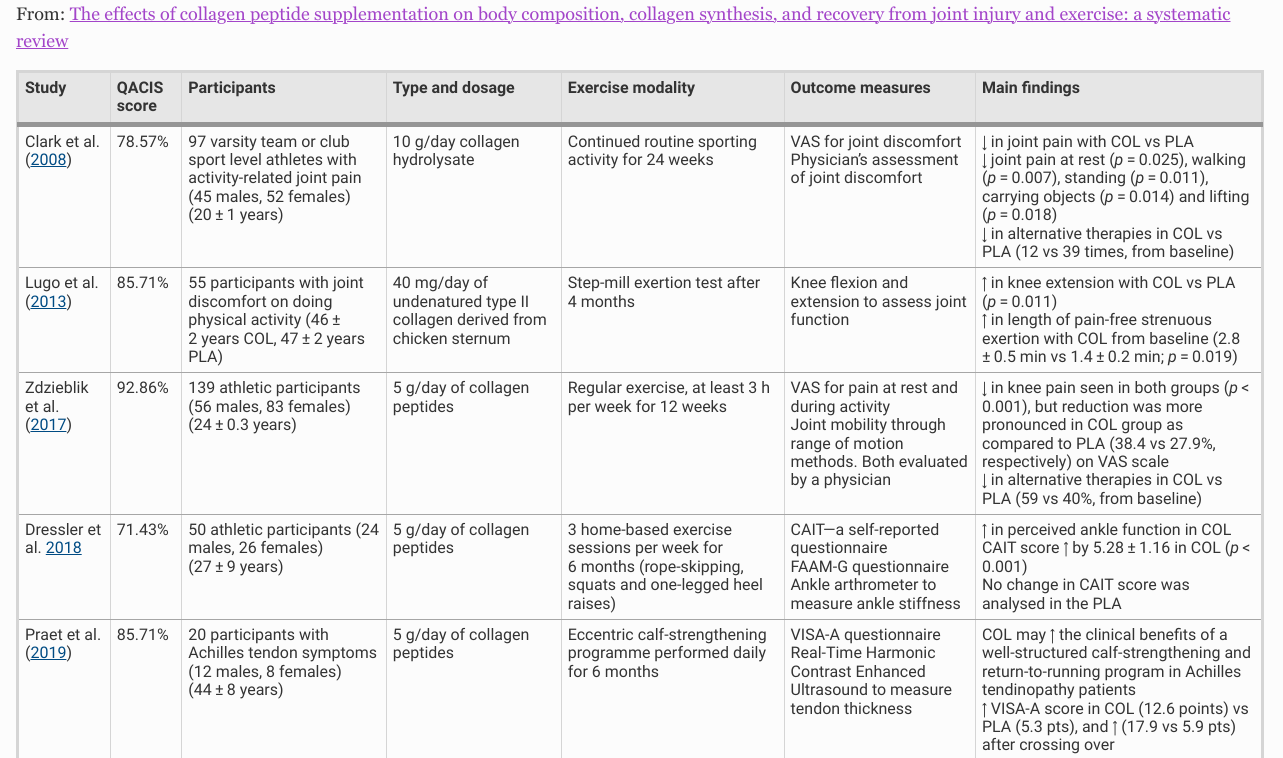
The joint pain included in the review included knee pain and Achilles tendinopathy, all predominately in an athletic population. Another glaring observation is several of these studies included physical therapy and exercise prescriptions with the supplementation (Yay! Nutrition and Physical Therapy), which can also alter the results and effects of collagen as well. It's important to see the doses varied in the studies from 5, 10, to 40 grams per day; moreover, the collagen can come in varying form from peptides, hydrolyzed proteins, to denatured collagen. Having such variability in the type of collagen also likely explains the variability in responses and data.
Dosing Collagen
So, roughly how much and what type of collagen should a client take? Well, many studies have used dosages ranging from 8 to 12 grams of collagen peptides or hydrolyzed collagen per day for joint-related benefits. Research suggests that type II collagen supplementation may help reduce joint pain and improve joint function in individuals with arthritis, particularly osteoarthritis. It is believed to work by helping to restore and support cartilage health, potentially reducing inflammation and promoting joint mobility. It's important to note that collagen supplements are available in various forms, such as powders, capsules, and liquids, and their concentration of collagen can vary. Therefore, it's crucial to follow the manufacturer's instructions and consult with a healthcare professional to determine the appropriate dosage for your specific needs.
It's also worth mentioning that collagen supplements are often combined with other ingredients, such as vitamins, minerals, or herbal extracts, which may influence their effectiveness. If you decide to try collagen supplementation for joint pain, it's a good idea to choose a reputable brand and look for products that have been tested for quality and safety. I suggest using Labdoor.com to help you or your client find a high-quality collagen supplement, if and when appropriate.
Summary
In the end, perhaps the participants at the ATAF conference were right -- there is something to say about collagen and joint pain. Not every study is exact and more research needs to be done on what dose, what age, what condition, and what exercises should be done with the collagen -- but that's why we practice physical therapy! Love to hear your thoughts and maybe some of your clients' responses to collagen.
If you like what you see here then know there is more in our 3 board-approved continuing education courses on Nutrition specific for Physical Therapists. Enroll today in our new bundled course offering and save 20%, a value of $60!

Photo by Towfiqu barbhuiya from Pexels: https://www.pexels.com/photo/close-up-photo-of-an-aching-man-holding-his-shoulder-8600449/
Keywords: nutrition, diet, continuing education, joint health, collagen, arthritis, PT, physical therapy, health, rehab, DPT
Complete Your CEUs & Save $148
Knock out 12 Board-Approved CEUs in one structured, self-paced curriculum. Get lifetime access to all 3 comprehensive courses, master clinical nutrition, and complete your license renewal requirements stress-free.
- 12 Continuing Education Units (CEUs) — FPTA approved with reciprocal acceptance.
- 100% Online & Self-Paced — Fit your hours seamlessly into your busy patient schedule.
- CNPT® Certification — PTs and PTAs can earn your credentials while fulfilling your state mandates.
Get All 12 CEUs Today for Only $299 (Save $148)
Recent Posts

Save $148 on 12 CEUs
Upgrade your clinical practice with the ultimate 3-Course Nutritional PT Bundle. Approved for 12 CEUs for PTs & PTAs.